By MechanicTap Team · Nov 11, 2026 · 9 min read
Customer-Supplied Parts Policy for Mobile Mechanics
When a customer hands you a part they bought online, you need a rule before you need a wrench. Here is which parts to accept, what to charge, and a policy you can copy.
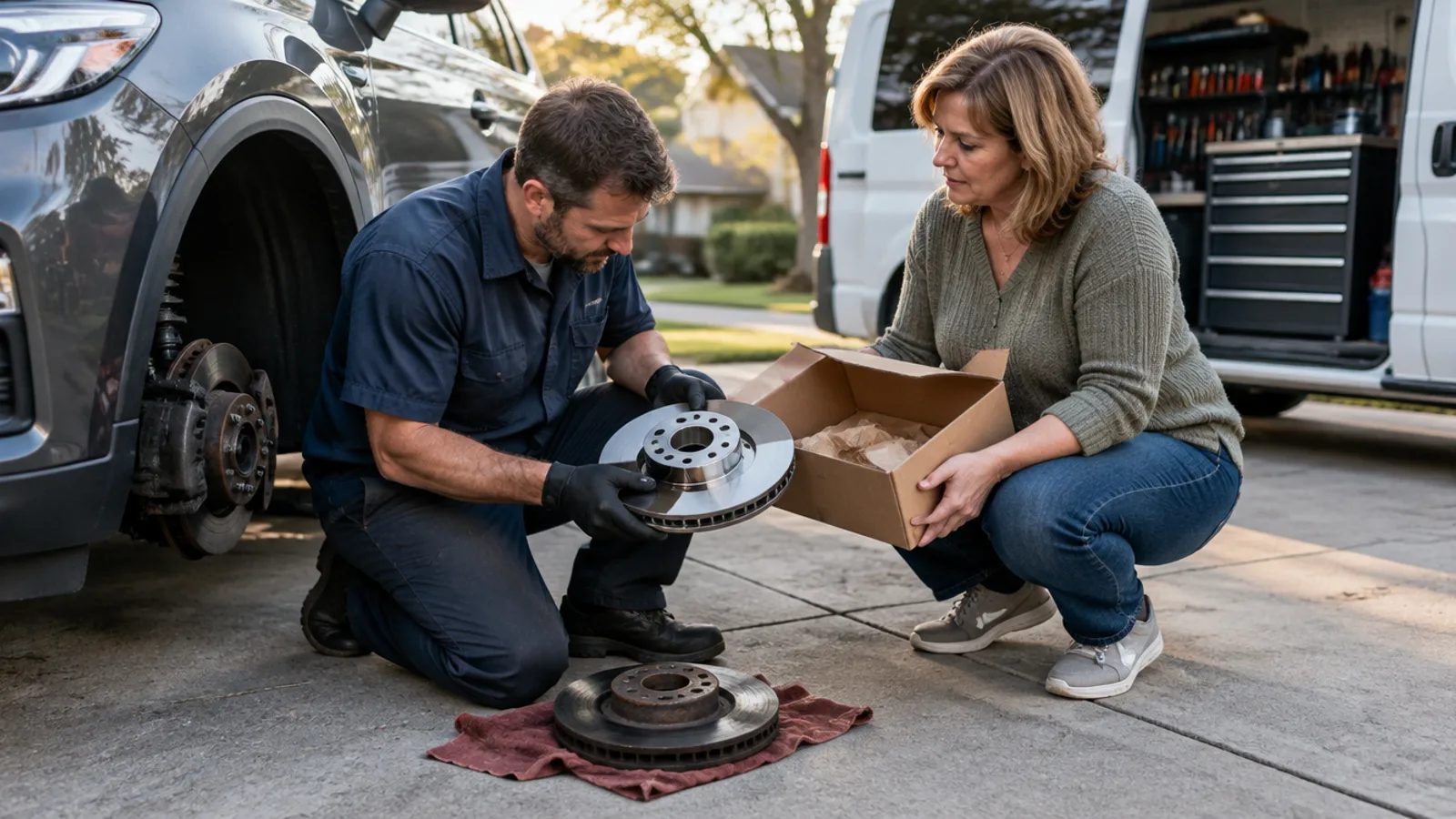
A mobile mechanic should allow customer-supplied parts on simple bolt-on jobs, refuse them for air bags and emissions parts, charge full labor, and give no warranty on the part or on labor to replace it if the part fails. Put the policy in writing on every quote: you inspect the part before starting, a wrong or defective part still owes the trip fee, a second visit is billed as a new visit, and the customer handles returns and core charges with the seller.
MechanicTap gives you a free booking page where customers send the vehicle or VIN, photos, and the car's location before you accept, so you can check what they bought before you drive out. On the Pro plan ($20 a month), you send quotes with labor, parts, and fees that customers approve on their phone and take a card deposit through Stripe to hold the visit; see what each plan includes.
Should a mobile mechanic install customer-supplied parts?
A mobile mechanic should install customer-supplied parts on low-risk jobs where a bad part costs only time, and decline them where a bad part can hurt someone or break an emissions law.
The risk is bigger for a mobile mechanic than for a shop. A shop with a wrong part can order the right one and keep the car in the bay overnight. In a driveway, a wrong part usually ends the visit, and the fix is a second trip you were never paid for.
Noah Nelson, technical editor at Motor Age, wrote in May 2026 that a shop's standard labor warranty can end up covering a customer-supplied part unless the shop excludes those parts in writing. He estimates each comeback at three to five hours of unbillable time, and a mobile comeback adds the drive on top.
Which customer-supplied parts should you refuse?
Refuse customer-supplied air bags, air bag inflators, and catalytic converters that aren't legal for the state, and inspect brake and steering parts before agreeing to install them. Low-risk maintenance parts are the easy yes.
| Part type | Policy | Reason |
|---|---|---|
| Air bags, inflators, seat belt parts | Refuse | NHTSA has tied counterfeit DTN60DB inflators to 11 deaths. |
| Catalytic converters | OEM or state-legal only | California requires a CARB Executive Order for the exact vehicle. |
| Brake pads, rotors, calipers, hoses | Inspect first, name brands only | A failed brake part is a safety failure, not an inconvenience. |
| Tie rods, ball joints, control arms | Inspect first, name brands only | Steering and suspension failures can cause a crash. |
| Used engines and transmissions | Labor only, signed waiver | Nobody can confirm the condition before install. |
| Batteries, bulbs, wipers, filters, plugs, belts | Allow | Fitment is easy to check and a bad part is cheap to fix. |
NHTSA Administrator Jonathan Morrison said on September 23, 2026, that the agency had issued its first equipment ban against an aftermarket component in over twenty years, aimed at Chinese-made air bag inflators marked DTN60DB. The DTN60DB inflators are linked to eleven deaths and can explode on deployment and send metal fragments into the cabin.
NHTSA also said Facebook Marketplace, Amazon, Alibaba, and eBay stopped selling the inflators and modules, and that critical safety parts selling online for a fraction of their normal price should be treated as a red flag.
Catalytic converters carry legal risk. The California Air Resources Board requires an aftermarket converter to have an Executive Order exemption that covers the specific vehicle, and a used converter cannot be legally sold or installed in California after July 10, 2008. Colorado has required every replacement converter to be OEM or a new CARB-certified unit since January 1, 2021, and a car still under its emissions warranty must get an OEM converter there.
Brake pads face state rules in some places. Washington's Better Brakes law requires pads manufactured after January 1, 2025, to contain less than 0.5% copper, and a box with all three LeafMark leaves darkened (Level N) meets the 2025 standard. Check for the mark before installing a customer's pads in Washington.
Should you warranty labor on customer-supplied parts?
Warranty your own workmanship for a stated period, and give no warranty on a customer-supplied part or on the labor to replace it if the part fails.
The parts store will not pay for your time either. AutoZone's limited warranty promises a replacement or refund and excludes damage caused by improper installation or other faulty parts. The FTC's sample limited warranty for businesses offers free replacement parts but not the labor to install them, and tells the customer they must pay any labor charges.
The federal Magnuson-Moss Warranty Act does not apply to warranties on services, according to the FTC's Businessperson's Guide to Federal Warranty Law. A warranty that covers both parts and workmanship is covered by the Act, and the FTC requires written warranties on consumer products costing more than $10 to be titled full or limited. Keep your labor warranty short and plain, and check your own state's rules.
How much should you charge to install customer-supplied parts?
Charge your full labor rate and your normal trip fee, then add a customer-parts fee or a higher labor rate to replace the margin and risk you normally carry on parts. Never discount labor because the customer bought the part.
- Same rate plus a flat fee: your standard labor and trip fee, plus a fixed customer-parts fee per job. Example only: a $25 fee on every customer-parts job.
- Higher labor rate: a set percentage added to labor on customer-parts jobs. Example only: 20% more labor than your posted rate.
- Labor-only minimum: a minimum charge for any customer-parts visit, so a 20-minute install still pays for the drive.
- Inspection fee: a small charge to check a part before you commit, credited to the job if the part passes.
Collect the trip fee up front on customer-parts jobs, because the part, not the customer, is the most common reason the visit ends early. Stripe charges 2.9% plus 30 cents for a domestic card payment and $15 for each dispute received, so a card deposit costs little and a chargeback costs more. The guide on what to charge for a mobile mechanic trip fee shows how to word that fee on a quote.
What happens if the customer's part is wrong or defective?
If the customer's part is wrong or defective, stop before installing it, photograph it next to the old part, and charge the trip fee or the time already spent, as your written policy says. Then offer to supply the right part yourself or rebook once the customer has it.
- 1Ask for the part number, brand, and a photo of the box when the customer books, and match the number to the VIN before you drive out.
- 2Open the box on site and compare the new part with the old one before removing anything you can't put back the same day.
- 3If the part is wrong, damaged, or a counterfeit-looking safety part, stop and photograph it beside the old part.
- 4Tell the customer what the trip fee covers and offer two choices: you supply the correct part today, or the customer exchanges it and rebooks.
- 5Keep the photos with the quote.
Don't install a part you doubt, because an installed part may lose its refund. AutoZone's return policy asks for the item in its original condition and packaging, with the receipt, within 90 days of purchase, and says refunds may be denied if the item has been used or installed.
Cores belong in the policy too. AutoZone defines a core as the old part that was replaced, credits the core value only if the core passes inspection, and requires all fluids to be drained before a core is returned. A customer-parts policy should say the customer keeps the old part and handles the core return with the seller.
What should a customer-supplied parts policy say?
A customer-supplied parts policy should say which parts you accept, that the part gets no warranty from you, what you charge if the part is wrong, and who handles returns and cores. Put the policy on your booking page and in every quote where the customer supplies a part.
Write customer-supplied parts on the paperwork, line by line. In California, the Bureau of Automotive Repair treats every part on an estimate as new unless the estimate identifies the part as used, rebuilt, or reconditioned, and invoices must state the condition of each part. Mark the customer's part as customer-supplied with its brand and number, so nobody later assumes you sold it.
California's BAR also requires the customer's authorization to be recorded on the estimate before any repair begins, and requires repair records to be kept for at least three years.
How do you explain the policy to customers without losing the job?
Explain the policy as a choice about who stands behind the part: when you supply it, you warranty the part and the labor, and when the customer supplies it, the seller warranties the part and the customer pays for labor if it fails.
- When they ask if you'll use their part: "Yes, I can install it. Send me the part number and brand so I can check it fits your car before I come out."
- When they ask why there's no warranty: "If I supply the part, I cover the part and my labor. If you supply it, the store covers the part, and a redo is billed as a new job."
- When they ask about their car warranty: "Using an aftermarket part doesn't void your factory warranty by itself. The FTC says the maker has to prove the part caused the damage."
- When they bring an air bag or a cheap converter: "I don't install those from outside sellers. I can quote you a part I'd stand behind."
The car-warranty line is backed by the FTC: a manufacturer warranty stays in effect when the owner uses aftermarket or recycled parts, and the manufacturer or dealer must prove the part caused the damage.
When a customer's part fails during the job and a replacement is needed, MechanicTap's Pro plan lets you send an extra-work approval the customer signs off on their phone, and quotes break out labor, parts, and the mobile fee on their own lines. The guide on how to stop no-shows and take deposits as a mobile mechanic covers holding the visit with a card deposit, and MechanicTap's features page shows the full quote and deposit flow.


Frequently asked questions
Can I refuse to install parts a customer bought?
A mobile mechanic sets their own job policy, and many decline customer-supplied parts or accept only certain types. State the policy on your booking page so customers know before they book.
Does using my own parts void my car's warranty?
A manufacturer warranty stays in effect when you use aftermarket or recycled parts, according to the FTC. The manufacturer or dealer must prove the aftermarket part caused the damage before denying a claim.
Who keeps the core when a customer supplies the part?
The customer should keep the old part and return the core to the seller for the core credit. AutoZone, for example, credits a core only after the core passes inspection and requires fluids to be drained first.
Do I need a signed waiver for customer-supplied parts?
A signed waiver helps but is not a guarantee, Motor Age's technical editor wrote in May 2026, and he recommends having a local attorney review the wording. Ask your insurer how your liability policy treats jobs with customer-supplied parts.
Should I charge a trip fee if the customer's part is wrong?
Charge the trip fee when a customer-supplied part is wrong or defective, as long as the fee is in your written policy before the visit. Collecting the fee as a deposit when the job is booked avoids the argument in the driveway.
Sources
- 1.NHTSA: Administrator's remarks at the IPRC Automotive Anti-Counterfeiting Council (Sept. 23, 2026)
- 2.California Air Resources Board: Aftermarket Catalytic Converters
- 3.Colorado Department of Public Health and Environment: Aftermarket catalytic converters
- 4.Washington Department of Ecology: Better Brakes Law
- 5.FTC: Auto Warranties and Auto Service Contracts
- 6.FTC: Businessperson's Guide to Federal Warranty Law
- 7.California Bureau of Automotive Repair: Write It Right
- 8.AutoZone: Terms and Conditions (return, core return, and limited warranty policies)
- 9.Stripe: Pricing
- 10.Vehicle Service Pros (Motor Age): The Customer-Supplied Parts Dilemma
This guide is general information, not legal, tax, or insurance advice. Rules vary by state and city, so check with your state, a tax professional, or a licensed agent before you decide.