By MechanicTap Team · Nov 4, 2026 · 9 min read
How Far Should a Mobile Mechanic Travel for a Job?
Drive time is the hidden cost in every mobile job. Here is how to set a service radius, price the outer zones, and turn down jobs that would cost you money.
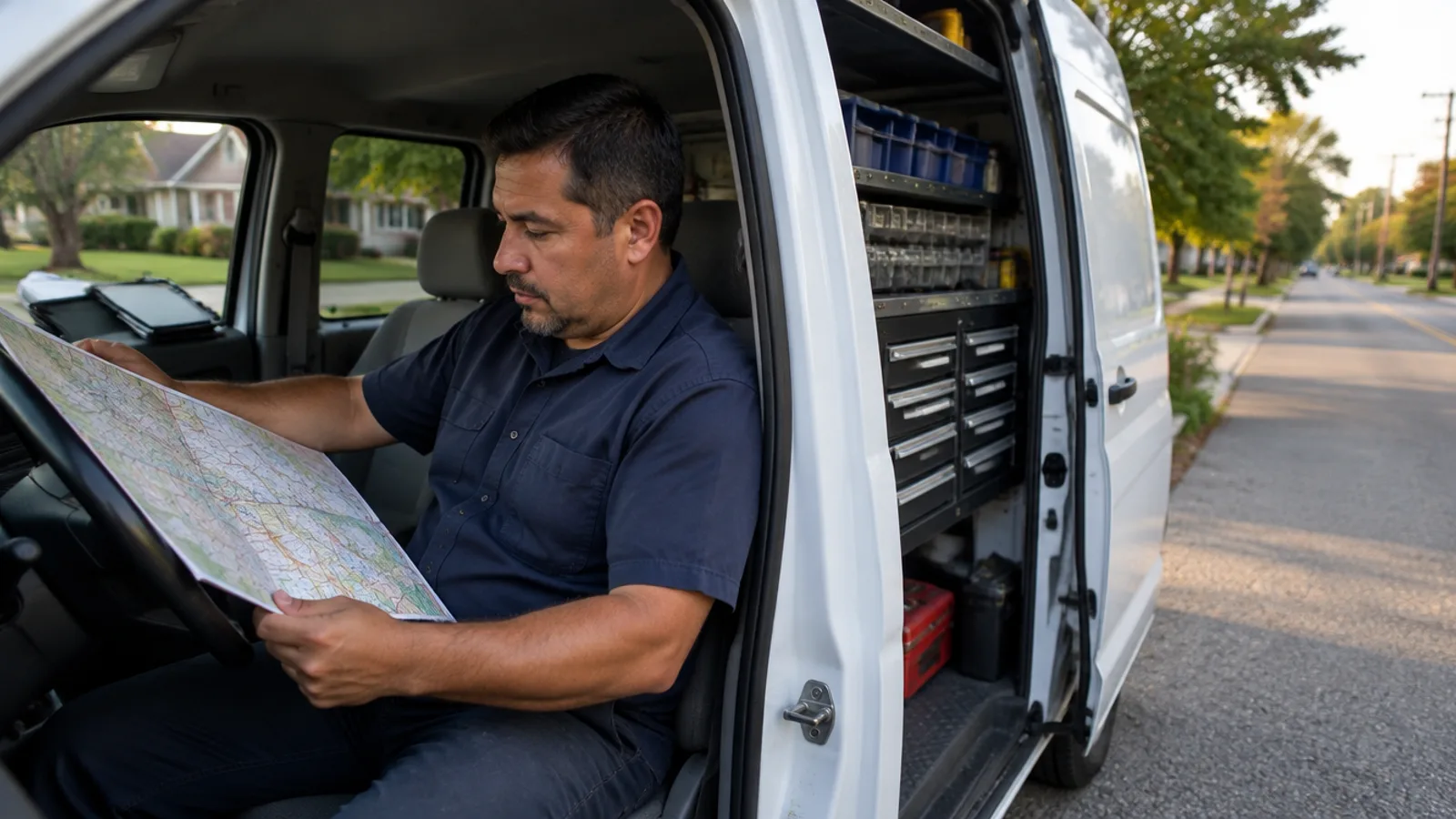
A good starting limit for a mobile mechanic is about 30 minutes of driving each way for any job, stretched to about 60 minutes only for larger jobs backed by a deposit. Set the limit by drive time, not miles, because a 50-mile round trip costs $38 in vehicle expense at the IRS business rate of 76 cents a mile before you count an hour or more of unpaid driving. Past the core area, charge a zone fee, set a minimum job size, and book those jobs on days you already work nearby.
MechanicTap gives you a booking page where customers enter the car's location, photos, and VIN before they send a request, so you see where the job is before you accept or decline it. Nothing is booked until you accept, and the Free plan includes the booking page and up to 5 bookings; see how the booking page works.
What service radius should a mobile mechanic start with?
Start with the area you can reach in about 30 minutes from where your day begins, and take any job inside it. Measure that area at the hours you actually drive, because a 30-minute circle at 7 AM can shrink to 15 miles at 5 PM.
A tight core area does three things for a new business. It keeps more of the day on billable work, it makes your trip fee easy to explain, and it puts your customers close enough together that two jobs in one morning is doable. Widen the area later when the core is full, not when the schedule is empty.
| One-way drive | Zone | Jobs to accept |
|---|---|---|
| 0 to 30 minutes | Core area | Any job, standard mobile service fee |
| 30 to 45 minutes | Outer zone | Jobs of about 2 labor hours or more, or booked next to another job nearby |
| 45 to 60 minutes | Extended zone | Big jobs, fleets, and regulars only, with a deposit and a zone fee |
| Over 60 minutes | Out of area | Decline or refer, unless the job fills most of a day |
The zone lines above are an example, not a rule. Draw yours from your own drive times, then put the fee for each zone in writing. The guide on what to charge for a mobile mechanic trip fee shows how to price each zone and word the fee on a quote.
What does a long drive to a job really cost?
A long drive costs you vehicle expense plus the value of your time, and the time usually costs more. The IRS business standard mileage rate is 76 cents per mile for July 1 through December 31, 2026, up from 72.5 cents for the first half of the year. That rate is a tax figure, but it is a fair benchmark for what each mile costs a working vehicle.
AAA's 2025 Your Driving Costs study puts the average cost of owning and running a new vehicle at 77 cents per mile when it is driven 15,000 miles a year. Trucks cost more: AAA lists a half-ton pickup at 98.54 cents per mile, the highest of any category it measured.
| Benchmark | Cost per mile | 50-mile round trip |
|---|---|---|
| IRS business rate, July to December 2026 | 76 cents | $38.00 |
| AAA 2025 average, all new vehicles | 77 cents | $38.50 |
| AAA 2025 mid-size pickup | 79.11 cents | $39.56 |
| AAA 2025 medium SUV | 83.89 cents | $41.95 |
| AAA 2025 half-ton pickup | 98.54 cents | $49.27 |
Fuel is a bigger share of that cost now than when AAA ran its numbers. AAA's 13 cents per mile for fuel assumed regular gas at $3.151 a gallon. The U.S. Energy Information Administration reported regular gasoline at $4.269 a gallon and on-highway diesel at $6.352 a gallon for the week of October 26, 2026. Scaled to that gas price, the fuel part alone is roughly 17.6 cents a mile, and a diesel service truck pays more.
Then add your time. Example only: a customer 25 miles away takes 40 minutes each way, so the round trip is 80 minutes. Even valued at the Bureau of Labor Statistics median technician wage of $24.34 an hour, those 80 minutes are worth $32.45. Valued at a $100 shop rate, they are worth about $133. Add the $38 vehicle cost and that one drive costs $70 to $171 before you loosen a bolt.
How long a drive is worth it for a small job?
A small job is worth a drive only when the drive takes less time than the job, or when the job sits next to another one you already booked. A 30-minute battery swap at the end of a 45-minute drive pays for 30 minutes of work and costs 90 minutes of driving.
- 1Look up the drive time from your previous job, not from home, at the hour you would leave.
- 2Double it for the round trip, or add the time to your next job if you are routing onward.
- 3Compare the drive time with the billable time on the job.
- 4If the drive is longer than the job, charge the zone fee, set a minimum charge, or offer a day when you are already nearby.
- 5If none of those work for the customer, decline politely and keep the slot for a closer job.
A minimum charge for the outer zones fixes most of this. One simple rule is to require that a job in the outer zone carry at least as many labor hours as the round trip takes. The exact number is yours to choose, but write it down so every quote follows the same rule.
Should you set your service area in miles or drive time?
Set your service area in drive time and publish it in miles or towns, because customers understand miles and drive time is what costs you money. Ten miles across a city at rush hour can take longer than 25 highway miles.
Use a map app with traffic set to your usual departure times and mark where 30, 45, and 60 minutes end in each direction. The shape will not be a circle. Rivers, bridges, toll roads, and highways stretch it in some directions and cut it short in others. List the towns or ZIP codes inside each line, and use that list on your booking page, your quotes, and your Google profile.

How should your Google Business Profile service area match your radius?
Your Google Business Profile service area should list the same towns or ZIP codes you actually serve, and Google says the whole area shouldn't be more than about 2 hours of driving time from where your business is based. Google lets a service-area business set up to 20 service areas by city, postal code, or another type of area.
- Google does not let you set a service area as a radius around your business, so list towns or ZIP codes instead.
- Google says to remove your address from the profile if you don't serve customers at that address, which is the normal setup for a mobile mechanic working from home.
- Google allows a service-area business only one profile for the whole area it serves, so don't create a second profile for a far town.
- Listing towns you won't drive to brings calls you will turn down, so keep the profile inside your extended zone.
The guide on which Google Business Profile category a mobile mechanic should pick covers categories, the hidden address, and verification for a service-area profile.
How do you take far-away jobs without losing money?
Take far-away jobs on zone days: pick one or two days a week for each outer area and offer distant customers only those days. Two jobs in the same far town on the same day split one drive between two tickets, and the second job often turns a losing trip into a good one.
- Charge a zone fee for each zone outside your core area and show it as its own line on the quote.
- Set a minimum job size for the outer and extended zones.
- Take a deposit before you buy parts or block half a day for a distant job.
- Route the day so the far job is first or last, closest to where you start or end.
- Group regulars, fleets, and used-car lots in the same area onto the same day.
On MechanicTap Pro, which costs $20 a month or $200 a year, a quote shows labor, parts, and the mobile service fee as separate lines, and the customer pays a card deposit through Stripe when approving it. Pro also includes expense and mileage tracking for tax time; see the Free and Pro plans.

Do you need a USDOT number to work across state lines?
You need a USDOT number if your service vehicle, or truck and trailer combined, is rated at 10,001 pounds or more and you drive it across a state line for business. The Federal Motor Carrier Safety Administration counts a trip between a place in one state and a place outside it as interstate commerce, and so is a trip between two places in one state that passes through another state.
Check the gross vehicle weight rating on the door-jamb sticker of your van or truck before you add a town across the state line to your service area. FMCSA also notes that some states, including Alabama, California, and Texas, require a USDOT number for commercial vehicles that stay inside the state. A neighboring state may also have its own repair-business and sales-tax rules, so check them before you advertise there.
How do you say no to a job that's too far?
Say no quickly, give the reason in one line, and offer the option that works for you, such as a zone day or a bigger job. A fast, clear answer keeps the door open for the customer's next repair.
Frequently asked questions
Is a 25-mile radius good for a mobile mechanic?
A 25-mile radius works well when most of it can be driven in about 30 minutes. In a city with heavy traffic, 25 miles can take an hour each way, so draw the service area from drive time and treat the far edge as an outer zone with its own fee.
How do mobile mechanics charge for long-distance travel?
Mobile mechanics usually charge for long-distance travel with distance zones, a per-mile charge past a set distance, or a custom quote for very long trips. Whatever the method, the travel charge should appear as its own line on the written quote before you dispatch.
What is the IRS mileage rate for business driving in 2026?
The IRS business standard mileage rate is 72.5 cents per mile for January 1 through June 30, 2026, and 76 cents per mile for July 1 through December 31, 2026. Keep a mileage log and ask a tax professional which of your miles count as business miles.
Should I widen my service area when I'm slow?
Widening the service area when you're slow fills the calendar with long drives that pay less per hour. Fill the core area first with a Google Business Profile, local referrals, and repeat customers, and add outer zones once the core keeps you busy most days.
What if a regular customer moves outside my area?
A regular customer who moves outside your area can stay on the books under your extended-zone rules: a zone fee, a minimum job size, and a zone-day appointment. Tell the customer the new terms once, in writing, before the next visit.
Sources
- 1.Manage your service areas for service-area and hybrid businesses (Google Business Profile Help)
- 2.Standard mileage rates (IRS)
- 3.Your Driving Costs 2025 fact sheet (AAA)
- 4.Gasoline and Diesel Fuel Update (U.S. Energy Information Administration)
- 5.Do I need a USDOT number? (Federal Motor Carrier Safety Administration)
- 6.Automotive Service Technicians and Mechanics, Occupational Outlook Handbook (U.S. Bureau of Labor Statistics)
This guide is general information, not legal, tax, or insurance advice. Rules vary by state and city, so check with your state, a tax professional, or a licensed agent before you decide.