By MechanicTap Team · Oct 21, 2026 · 10 min read
Should I Pay a Mobile Mechanic Upfront?
A deposit is normal. Paying the whole bill before any work is not. Here is how much a fair deposit is, the safest way to pay it, and the red flags that point to a scam.
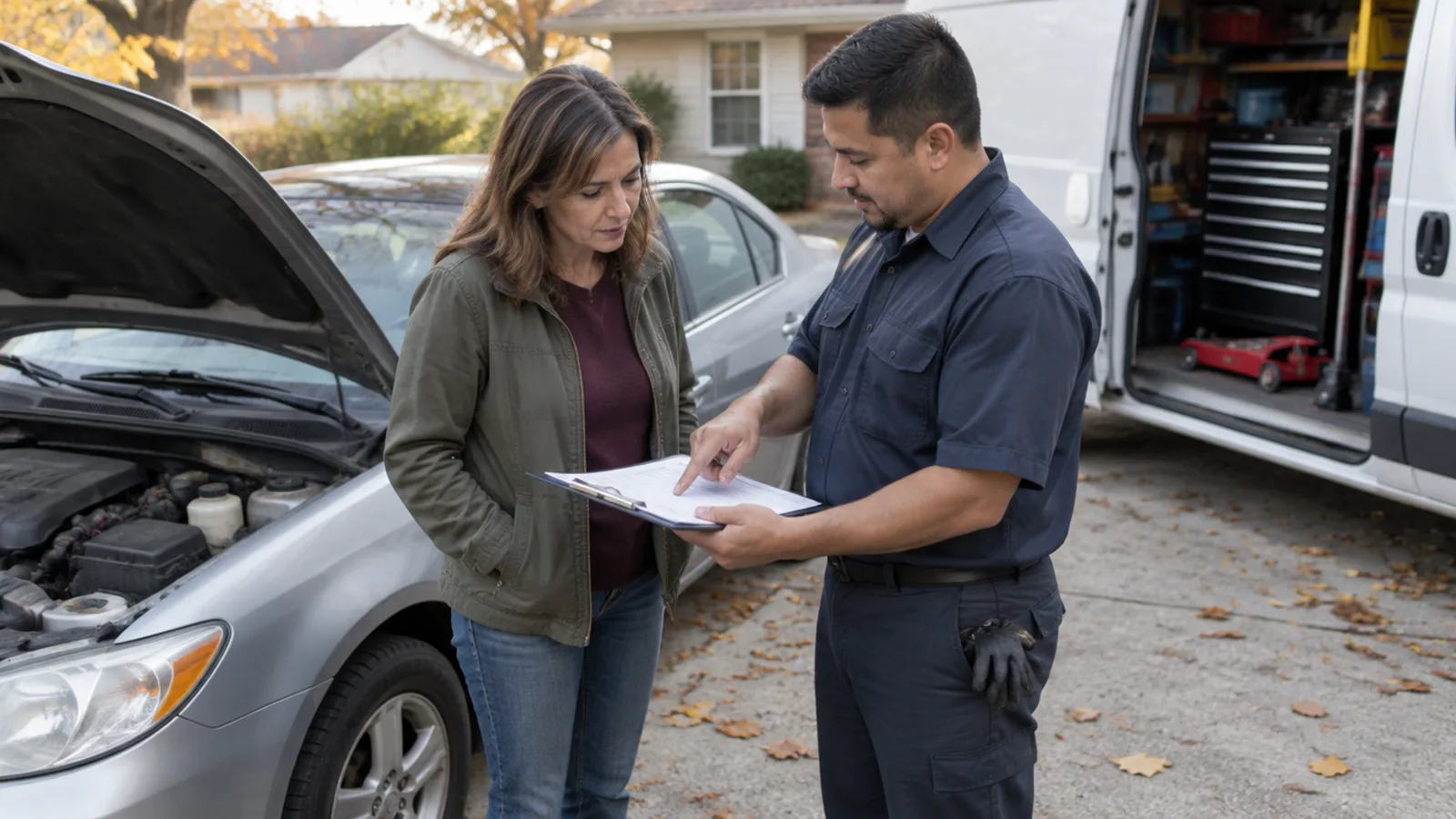
Don't pay a mobile mechanic the full price upfront, but paying a deposit before the visit is normal. A fair deposit is a set dollar amount written on the estimate, such as the cost of parts the mechanic has to buy for your car or a trip fee, with the rest due after the work is done. Pay the deposit by credit card, because a card charge for work that was never done counts as a billing error you can dispute within 60 days of the statement, while Zelle and Cash App payments usually can't be canceled once sent.
If you need a mobile mechanic, MechanicTap's Find a Mechanic lists independent mobile mechanics who take requests through their own booking page, where you send the problem, your vehicle or VIN, photos, and the car's location before anyone quotes a price. Mechanics on MechanicTap's Pro plan text you an itemized quote that shows the total and the deposit due to book, and you pay that deposit by card through Stripe only after you approve the quote.
Is it normal for a mobile mechanic to ask for money upfront?
Asking for a deposit before the visit is normal for a mobile mechanic, and asking for the whole bill before any work is done is not.
The reason for a deposit is practical. A mobile mechanic has no parts room, so parts are usually bought for one specific car and one specific job. Motor1, covering a mobile mechanic who walked away from a radiator job after the customer refused to pay for parts in advance, reported that mobile mechanics usually don't keep inventory and that paying for parts upfront protects them when a job falls through and a part can't be returned. The same article noted that labor is usually paid after the job is finished.
Mechanics explain their side in how to stop no-shows and take deposits as a mobile mechanic: a no-show costs them the drive, the time slot, and sometimes the parts.
How much of a deposit is reasonable for a mobile mechanic?
A reasonable mobile mechanic deposit is a fixed dollar amount that matches what the mechanic loses if you cancel: the trip fee, the diagnostic fee, or the cost of parts ordered for your car. A deposit should come off your final bill, and the estimate should say so.
| Deposit type | What a fair deposit covers | Red flag version |
|---|---|---|
| Trip or service-call fee | The drive to your address, listed as its own line on the estimate | A "gas money" request with no estimate and no business name |
| Diagnostic fee | Time spent finding the problem when the cause isn't known yet | A diagnostic fee that is never credited or explained in writing |
| Parts deposit | The listed price of parts bought for your car, such as a radiator or a set of pads and rotors | A parts deposit larger than the parts listed on the estimate |
| Flat booking deposit | A small set amount that holds the appointment and comes off the total | A booking deposit with no written policy for cancellations |
| Full prepayment | Rarely fair for a new customer, because labor is normally paid after the work | The entire bill, labor included, demanded before the mechanic arrives |
For scale, the example quote below is for brake pads and rotors on a 2017 Toyota RAV4: a $411 total with $50 due to book.

What is the safest way to pay a mobile mechanic upfront?
A credit card is the safest way to pay a mobile mechanic upfront, because a charge for services that weren't delivered as agreed is a billing error under federal rules. The FTC says you must send the dispute in writing within 60 days after the first statement showing the charge, and California's Attorney General adds that the card company then has 30 days to confirm it got your letter and 90 days to investigate.
A debit card is weaker. The FTC warns that debit cards have different protections and that you may not get a refund for non-delivery. Card networks also set their own dispute windows: Stripe's documentation says networks typically allow cardholders 120 days, and for a service booked in advance the window generally starts on the appointment date, not the payment date.
Payment apps are built for people you already know. Chase says to send Zelle payments only to people and businesses you know and trust, and Cash App says never to pay someone you don't trust for something promised in the future. A repair you haven't received yet is that kind of promise.
| Payment method | If the mechanic never shows up | Best use |
|---|---|---|
| Credit card | A charge for work never done is a billing error you can dispute in writing within 60 days of the statement (FTC) | Deposits and any payment before the work |
| Debit card | The FTC warns you may not get a refund for non-delivery | Paying the balance after the work is done |
| Zelle | Chase says a sent Zelle payment is usually final | Paying a mechanic you know after the work |
| Cash App | Cash App says payments are instant and usually can't be canceled | Paying a mechanic you know after the work |
| Venmo | Venmo Purchase Protection covers only payments to an authorized business profile or payments tagged as a purchase | A tagged purchase or a business profile, not a friends payment |
| Cash | No way to get money back except asking or small claims court | Paying the balance after you've checked the work |
Paying in full can cost you a second protection. California's Attorney General explains that you can raise a quality problem with your card company only if the disputed amount is over $50, the seller is in your state or within 100 miles of your billing address, you tried in good faith to fix it with the seller, and you haven't fully paid the charge. A deposit followed by payment after the work keeps that option open.
What are the red flags of a mobile mechanic scam?
The biggest red flag is a mechanic who will take money before the visit only by bank transfer, wire, payment app, gift card, or crypto, because the FTC says anyone who tells you those are the only ways to pay is probably a scammer. The FTC's July 2026 alert says people reported more than $4 billion in losses last year from scams paid by bank transfer or cryptocurrency.
- Payment only by Zelle, Cash App, wire, gift card, or crypto, with no card option for the deposit.
- The whole bill, labor included, demanded before the mechanic arrives.
- No written estimate, or a price given only over the phone.
- No business name, or a business name that doesn't match the payment recipient.
- A "gas money" or "parts run" request with no estimate behind it.
- Pressure to pay right now to "hold the slot" for a job days away.
One red flag doesn't prove a scam, but no estimate plus app-only payment plus pressure should stop you.
What should a legitimate deposit request include?
A legitimate deposit request comes with a written estimate that names the business, lists the parts, labor, and fees, shows the deposit amount, and says what happens to the deposit if either side cancels. The FTC tells consumers that an estimate should identify the condition to be repaired, the parts needed, and the anticipated labor charge, and to get a signed copy.
- 1Send the mechanic your vehicle, VIN, symptoms, and photos so the estimate is based on facts.
- 2Get the estimate in writing, by text, email, or a quote link, before you pay anything.
- 3Check that the deposit amount is on the estimate and that the estimate says the deposit comes off the total.
- 4Ask for the cancellation policy in writing: when the deposit is refunded, when it is kept, and what happens to parts already ordered.
- 5Pay the deposit by credit card when the mechanic offers it.
- 6Save the estimate, the policy, the receipt, and your texts in one place until the job is done and you are satisfied.
A good mechanic won't mind that text. To see what mechanics need from you for a firm price, read how to quote car repairs over the phone as a mobile mechanic.
What do state repair laws say about estimates for mobile mechanics?
In California, a repair dealer must give you a written estimate before doing any work, and in Florida, a repair shop must give you a written estimate before diagnostic or repair work that will cost more than $150 unless you choose to waive it. Rules vary in other states, so check with your state attorney general or consumer protection office.
- California: the Bureau of Automotive Repair says a business that does mobile repairs exclusively must register each vehicle separately, with the vehicle's license plate number as part of the registered business name.
- California: a mechanic who gets your approval for extra work by phone must record your name, phone number, and the date and time of the approval on the invoice, according to the Bureau of Automotive Repair.
- California: the final invoice must show the shop's name, address, and Automotive Repair Dealer (ARD) number.
- California: you can check a repair dealer's registration at search.dca.ca.gov or by calling 800-952-5210.
- Florida: the written estimate disclosure gives you three choices: request a written estimate, set a dollar limit the shop can't exceed without your approval, or decline a written estimate.
- Florida: the state's repair shop registration law includes mobile motor vehicle repair shops and lists the owner's home address when it differs from the business address.
When should I pay the rest of the bill?
Pay the balance after the work is finished and you have checked it, and get a completed invoice before you hand over the rest. The FTC says a completed repair order should list each part, its cost, the labor charges, and the vehicle's odometer reading.
- Start the car and, when it's safe, take a short drive before you pay the balance.
- Ask for your old parts when you approve the estimate, not after; California requires a shop to return replaced parts only if you ask before the work is done.
- Get any warranty in writing, because the FTC says there is no standard warranty on repairs.
- Pay the balance by card if you have any doubt about the work, so you keep your dispute options.
Mechanics on MechanicTap's Pro plan can collect the balance on the spot with a QR code or a texted pay link, so you can pay by card in the driveway after you've seen the work. Mechanics on any MechanicTap plan can also mark a job paid when you pay by cash, Zelle, Venmo, or Cash App.
Frequently asked questions
Should I pay a mobile mechanic for parts before the job?
Paying for parts before the job is reasonable when the mechanic orders parts specifically for your car and the written estimate lists those parts and their prices. Ask for the parts receipt, and ask for your old parts back when you approve the estimate.
Can I get my deposit back if the mobile mechanic doesn't show up?
A deposit paid by credit card for work that was never done can be disputed with your card company as a billing error, in writing, within 60 days of the statement that first shows the charge. A deposit sent by Zelle or Cash App is usually final once sent, so your options are asking the mechanic for a refund or filing in small claims court.
Is it OK to pay a mobile mechanic with Zelle or Cash App?
Zelle and Cash App are fine for paying the balance to a mechanic you have met, after you've checked the work. Chase and Cash App both say to send money only to people you know and trust, so avoid either app for a deposit to a mechanic you've never met.
What happens to my deposit if I cancel?
Whether you get a deposit back after canceling depends on the cancellation policy the mechanic gave you in writing before you paid. Ask for that policy before paying, and expect to lose some or all of a parts deposit if the parts were already bought for your car.
Is it a red flag if a mobile mechanic asks for gas money?
A trip fee is normal when the mechanic lists it on a written estimate and credits or explains it in writing. A "gas money" request with no estimate, no business name, and payment only by app is a red flag.
Sources
- 1.Federal Trade Commission: A way to spot scams: how someone asks you to pay (July 2026)
- 2.Federal Trade Commission: What to do if you're billed for things you never got
- 3.California Attorney General: Credit cards, disputing a charge
- 4.Federal Trade Commission: Auto repair basics
- 5.California Bureau of Automotive Repair: A consumer's guide to auto repair
- 6.California Bureau of Automotive Repair: Mobile automotive repair
- 7.California Department of Consumer Affairs: Check a Bureau of Automotive Repair license
- 8.Florida Statutes section 559.905 (2024): Written repair estimate and disclosure
- 9.Florida Statutes section 559.904 (2024): Motor vehicle repair shop registration
- 10.Chase: Help keep your money safe when using Zelle
- 11.Cash App: Recognize scams and keep your money safe
- 12.Venmo: Buying and selling on Venmo FAQ
- 13.Stripe Docs: How disputes work
- 14.Motor1: Toyota driver calls mobile mechanic, then they argue over who pays for the parts up front
This guide is general information, not legal, tax, or insurance advice. Rules vary by state and city, so check with your state, a tax professional, or a licensed agent before you decide.